
The Science of Cultural Evolution
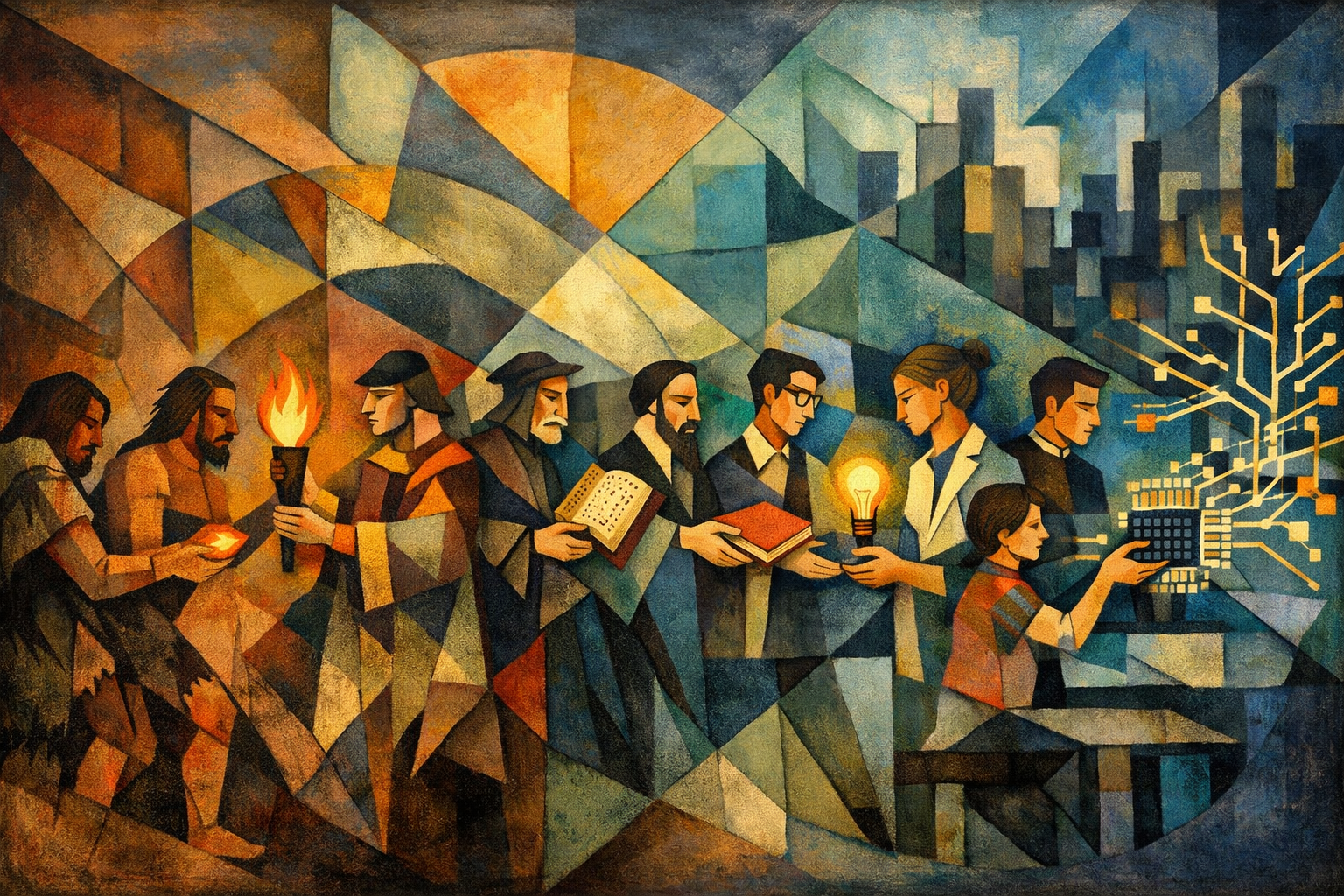
From the third episode of the Transmissions Podcast, created by the Cultural Evolution Society and featuring, in this episode, Dr. Tim Waring (emphases mine):
How do we use the evolution of culture to effect positive social change? And this is only just starting because the science of cultural evolution is still quite new. But I think a lot of us believe that there are ways in which a cultural evolutionary theory set and insights from it are integrative in a way that gives us a better understanding of the way the entire system changes, because it includes aspects from psychology and economics and anthropology and can integrate with the natural sciences. The question is how. How can we use an applied science of cultural evolution to create beneficial social change? And I think there are a couple of tentpoles in that effort.
I think the first one is understanding that culture is transmitted between people. This is basic, right? So, human social learning is very important, but also often kind of neglected, because most of human behavior is influenced by some kind of social learning. Our behavior is so deeply steeped in cultural transmission—and the problem is cultural transmission is basically ubiquitous, powerful, complex, but also invisible and very easy to fail to measure. So that’s the first one.
I can’t help but hear and see a note of frustration circling the expression of transmission’s primacy in social life and the importance of social learning. I can relate. And I can do so with nearly the same resignedly jovial and fatalistic mien, since education—my home turf—has not only never been exposed to these basic ideas, it works at cross-purposes to them, preferring, almost exclusively, staged asocial learning over social learning; individualism over cultural commonality; and, instead of real science, a pseudoscientific advocacy in which transmission shows up easily and obviously but no one is allowed to talk about it.
The path to scientific enlightenment for education seems both steep and long, not least because it practices what it preaches, creating hyperindividualistic social sciences, out for themselves, unable—and unwilling—to come to conclusions:
When I learned about evolution in depth in secondary school and high school, I just loved it. And I loved everything about the way that evolutionary theory gives us a way to understand the complexity and diversity and sophistication of a biological world. And then in college, I was disappointed by the social sciences . . . I was so unsatisfied with not only these ways to study culture that the social sciences give us, which are really—they’re an embarrassment. I mean, it really is. If you’re in a regular social science, you should be embarrassed for your discipline, because you’re not speaking the same language as other people who are studying the same species, and there’s only one set of behavior, and there’s only one study species. And if you can’t have the same theories and if you can’t use the same language and methods, you’re not doing your science very well. And that’s the case for all of the social sciences. They’re not living up to their promise.
It’s such a letdown, right? When you want to study the complexity of the human species, which is so fascinating, and so rich and diverse, and then you take an intro anthro[pology] class. And so that’s cool because there’s some diversity but it doesn’t get into the math. If you want math, you go to economics, and then you realize that they are using their math and they’re basing it on this unchecked assumption of rational action all the time and they’re not willing to really change that. And then you say, well maybe psychology. And psychology has lots of theories, but they don’t come together; there’s no central piece. And they don’t talk to each other.
Despite all this, I remain, with Dr. Waring, optimistic about the progress of the science of cultural evolution and its potential impact on the social sciences, such as they are. I have hypothesized, aloud, semi-formally in print, that the suite of biological capacities we call ‘consciousness’ in fact mark a very strong and likely starting line in prehistory for our activities as cultural transmitters, receivers, and interpreters—human consciousness, in other words, is the necessary ingredient that makes a culturally evolving human species possible. So, not only do I think the study is important; it is possibly one of the most important avenues of scientific thought we can pursue at this moment.
I’m interested in just the phenomenon of cultural evolution itself, because it’s completely novel and crazy, right? So, we are this species that is doing something that is so weird. And if you’re not sort of creeped out by how weird we are as a thing on this planet, I think you’re not looking at what we are with the right perspective. We’ve taken over the planet in the blink of an eye, but we definitely don’t know what we’re doing, although we’re clearly very sophisticated . . .
Cultural evolution gives us a lens that helps us explain important things. So, for example, the differences between technological change and social change. So, technological change tends to be very cumulative. When we invent a new system or a new tool, it tends to spread very widely, it tends to be used, and then we refigure everything we do based on the fact that we have this new tool. And that’s not the way social change works. Non-technological social change tends to depend on institutions and cooperation reinforcing each other, and when social identities shift, or other things shift, those things can just fall apart. And so, what’s nice about the science of cultural evolution is it gives us a way to understand how that happens. It gives us a way to understand why that is the way it happens.
Perhaps one day the science of cultural evolution will be able to fully explain why it took so long for the science of cultural evolution to gain real momentum. On this point, give Dr. Waring a listen above, about his early work in the Florida Everglades:
And we were never able to sort of go back and take the sugar cane fields, which were providing this runoff, which is changing the nutrient cycling in the Everglades—we were never able to do that. Still aren’t, still hasn’t happened. And so I became fascinated with the question of why have we not implemented the science when we know the science is there and the science gives us the solution. And so therefore, how is it that humans work? And I became very interested in how humans work and how they came to manage the environment the way they do.
I would hope, at the very least, that the presence of the science of cultural evolution can eventually convince enough people within education to start thinking bigger:
Currently, societies tend to last only around 300 years or something, on average. We wear out. Our social institutions are not durable like our technology is. And that’s important to know . . . .
This is a young scientific society with very diverse backgrounds. It’s increasingly globally diverse. There’s a long tail of people from all sorts of countries involved. We are studying diverse topics. I saw talks on the social learning of capuchin nut cracking, phylogenetic analysis of Gregorian chants, rice farming and collectivism in Japan, cultural evolution of literature, gender role ideology change among Tanzanian men, American religious sermon content, cultural adaptation to climate change. So, all of these very diverse topics that span all of the social sciences and connect with the natural sciences. So it has the possibility to be the integrative human science. And also, it’s super rigorous. There are cutting-edge methods. There’s Bayesian stuff, phylogenetic methods. There’s agent simulation. There’s experiments. There’s mathematical formal modeling. There’s all sorts of very rigorous tools that people are using. And it pulls together all of these . . .
We, in terms of our life on the planet as a species, we need a science of the human species that connects us to the natural world. And this is that science. That science is cultural evolution.
