
Thinking Too Much of Thinking
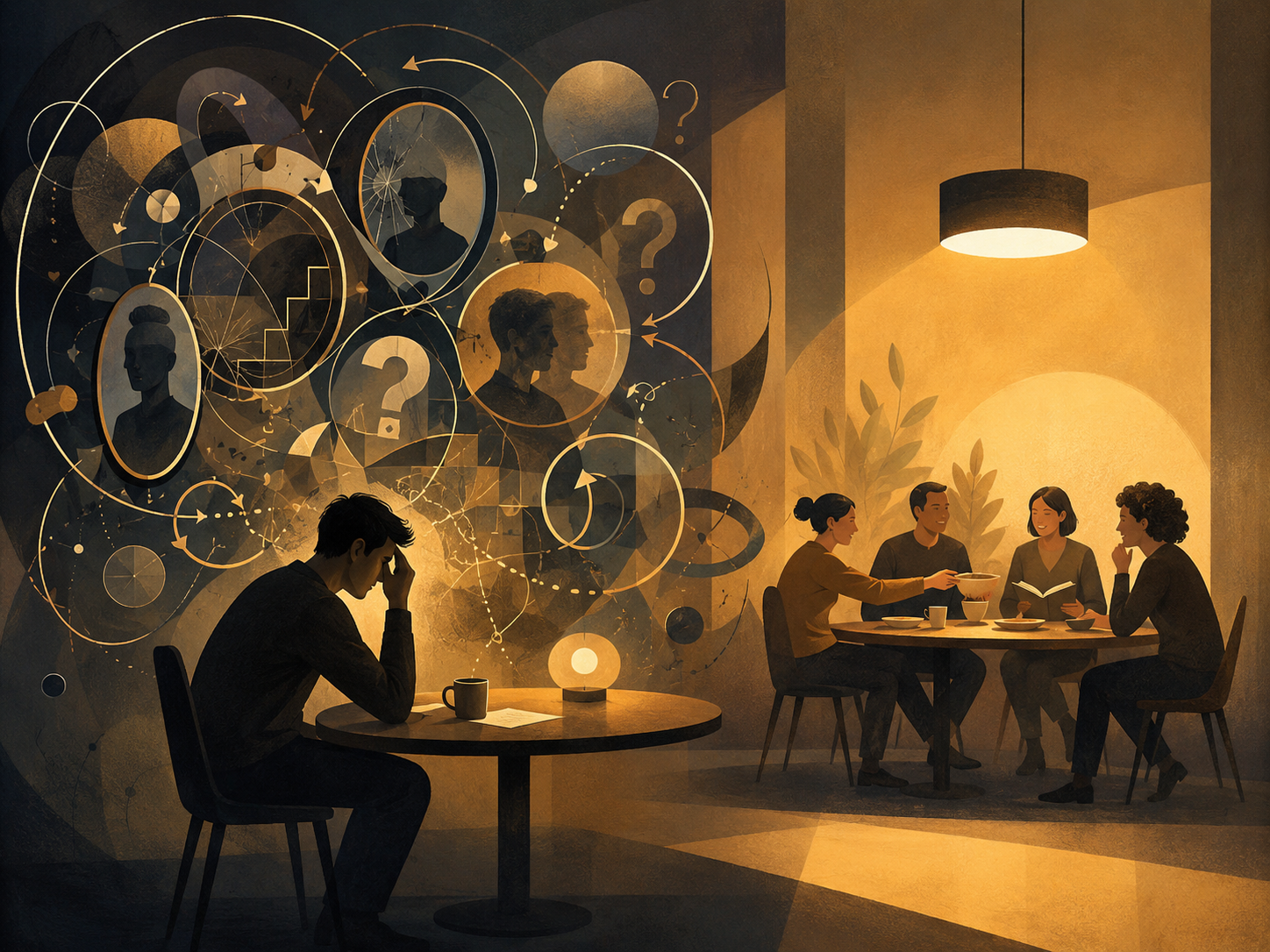
I have been thinking more about ‘thinking’—in particular, about what I take to be Western education’s obsession with the word.
‘Thinking’ seems to be the word one reaches for when they need the process of education to sound really locally dynamic and cognitive—as though something is getting done, now, you know? Some kilojoules of electric brain work are being produced, in the moment and in the abstract, and this something—especially in the abstract—is somehow discernible and directly manipulable by classroom teachers.
And since ‘thinking’ is somehow a thing, a quantity of some stuff, directly manipulable by classroom teachers, we can teach you to do it, right?
Nobel Laureates, captains of industry, cabinet ministers, school superintendents—any one of them is likely to end a commencement address or a discourse on the current crisis by declaring that schools have got to “teach students to think.” The words roll easily off the tongue and the speakers show not the slightest doubt that the words mean something. But do they? Why do we never hear about the need to “teach students to digest”? Like thinking, digestion is a vital natural process, it exhibits large individual differences, and it is influenced by psychological and environmental factors.
No. Teach students knowledge, and they will be better thinkers. We cannot tinker with their thinking directly, and it would not be ethical to do so even if we could. We can influence what they think about. Beyond that, we’re just making it up, and that’s irresponsible. The job has boundaries, and that’s one of them.
In his book 44 Poems on Being with Each Other, Pádraig Ó. Tuama features a poem that speaks well, I think, to the invisible consequences of just ‘thinking’—if you adopt a somewhat unorthodox, but I think defensible, interpretation. It is called “I Invite My Parents to a Dinner Party” by Chen Chen. Here are the first stanzas:
In the invitation, I tell them for the seventeenth time
(the fourth in writing), that I am gay.
In the invitation, I include a picture of my boyfriend
& write, You’ve met him two times. But this time,
you will ask him things other than can you pass the
whatever. You will ask him
about him. You will enjoy dinner. You will be
enjoyable. Please RSVP.
They RSVP. They come.
They sit at the table & ask my boyfriend
The remainder of the poem covers the dinner party and the narrator’s ‘thinking’ about it. One can find instant rapport with the narrator, not only because of the somewhat clichéd context, but also because the structure of the beginning of the poem casts the reader as the ‘receiver of spilling T’—the person to whom the narrator has turned to complain about and make fun of people who don’t seem to get him. And gossip is done amongst friends. One can practically see the body language produced by those repeated “In the invitation, I.”
But the narrator does much more ‘thinking’ than anyone else in the poem does anything else at all. This is poetry, of course. But, still, they come, sit, eat soup, smile, whisper, talk, and read the newspaper, and there is no drama or tragedy to it except that the narrator’s ‘thinking’ puts it there—that his parents must be treated like smiling seat fillers with some lines to read, like “scary, yet deeply incompetent burglars . . . watching from the outside,” that he must “orchestrate” every moment to form “proper” families with proper motherly mothers, that, for his boyfriend, a boring family dinner featured on a hundred different sitcoms is a
nonlinear slapstick meets
slasher flick meets psychological
pit he is now co-starring in
That he, in his brilliance, must coordinate, while others, in their dullness must follow. The line at the end of the poem breaks into this poisoned ‘thinking’: “Remind me.” His boyfriend is heard—perhaps not for the first time—asking the family:
Remind me
what’s in that recipe again
It’s as though the boyfriend and parents get along just fine—and have been getting along just fine—slowly and organically, without the narrator’s ‘thinking,’ as though the boyfriend occupies increasingly familiar social terrain and history while the narrator’s ‘thinking’ has accomplished nothing, except self-isolation. “Remind me” signifies shared meaning—a shared memory—and even a confabulated one is better than being alone, surrounded by others, with just your ‘thoughts,’ as our narrator seems to be.
At bottom, what worries me about education’s packaging and promotion of ‘thinking’—especially contentless thinking—is that it causes people to believe that full working memories—hard thinking—make productive people, or smart people, or intelligent people, or caring people, or, sheesh, knowledgeable people. But that’s not true. They usually just make stressed people, anxious people, busy people.
