
Working Memory and Consciousness
I have written a paper about consciousness with the help of the talented folks at The Observatory. I was raving about the ideas in the paper a few months ago online, which resulted in this preprint and a handful of follow-up articles.
To the extent that this thinking makes any real contribution, my only hope, at the moment, is that it points—somewhat accurately—at the place where human consciousness is most likely to be found, not as a mystical energy comprising the entire cosmos or every cell within it, nor even less ‘spookily’ as a lights-on phenomenon or internal self-reflection mechanism, but as an evolved trait that serves a species-beneficial purpose: allowing us humans to create and maintain intersubjective realities:
As far as we know, prior to the emergence of stories the universe contained just two levels of reality. Stories added a third.
The two levels of reality that preceded storytelling are objective reality and subjective reality. Objective reality consists of things like stones, mountains, and asteroids—things that exist whether we are aware of them or not. An asteroid hurtling toward planet Earth, for example, exists even if nobody knows it’s out there. Then there is subjective reality: things like pain, pleasure, and love that aren’t “out there” but rather “in here.” Subjective things exist in our awareness of them. An unfelt ache is an oxymoron.
But some stories are able to create a third level of reality: intersubjective reality. Whereas subjective things like pain exist in a single mind, intersubjective things like laws, gods, nations, corporations, and currencies exist in the nexus between large numbers of minds. More specifically, they exist in the stories people tell one another. The information humans exchange about intersubjective things doesn’t represent anything that had already existed prior to the exchange of information; rather, the exchange of information creates these things.
When I tell you that I am in pain, telling you about it doesn’t create the pain. And if I stop talking about the pain, it doesn’t make the pain go away. Similarly, when I tell you that I saw an asteroid, this doesn’t create the asteroid. The asteroid exists whether people talk about it or not. But when lots of people tell one another stories about laws, gods, or currencies, this is what creates these laws, gods, or currencies. If people stop talking about them, they disappear. Intersubjective things exist in the exhange of information.
Intersubjectivity itself—the space that allows for these stories—is made and kept open by joint attention (or what I call social consciousness) like this:
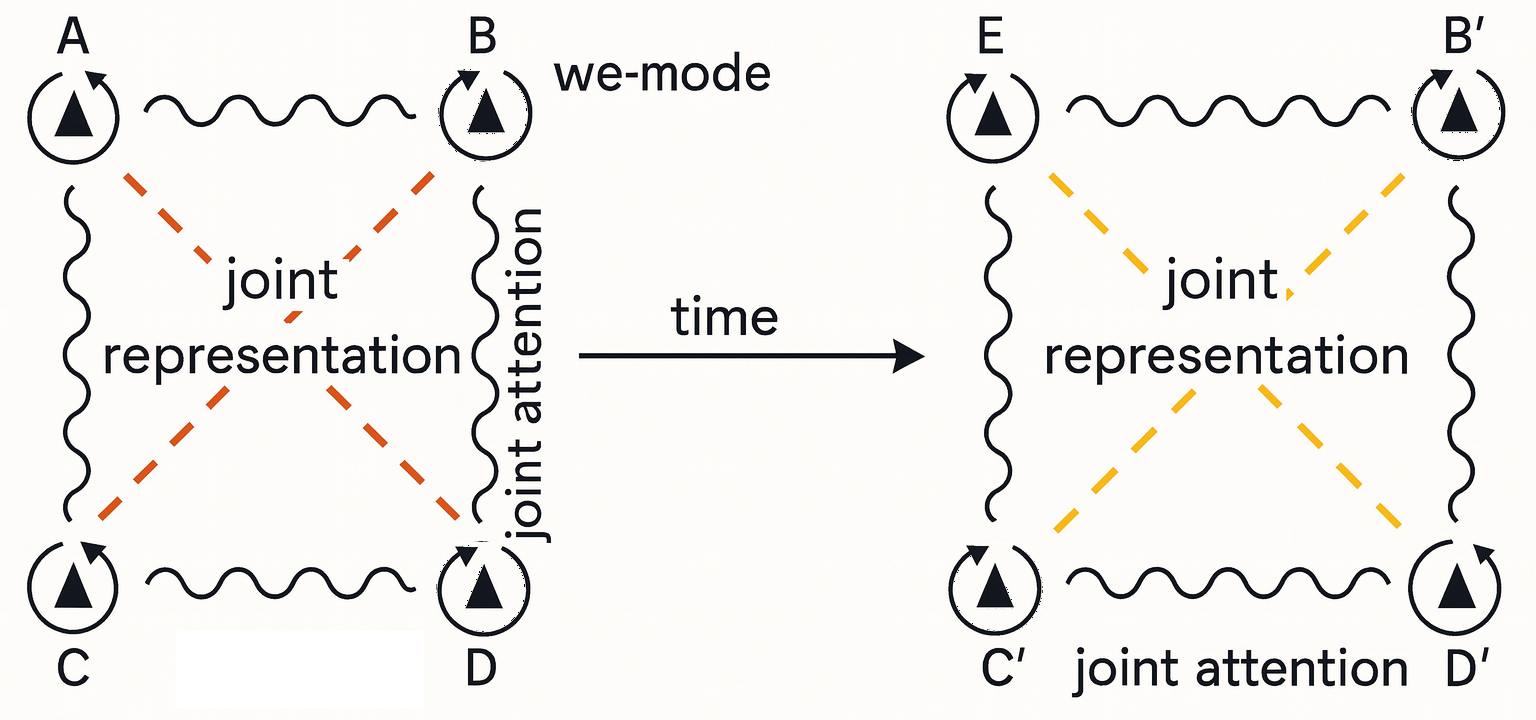
Let’s start with the left half of the diagram. There are four individuals, A, B, C, and D—though a minimum of two is required for joint attention. In humans, joint attention is not just ‘sharing’ attention on a particular object in the environment. Comparative primate research (PDF) indicates that gaze following is widespread across primates—including lemurs and monkeys—and appears in great apes in more sophisticated forms such as geometric gaze following (tracking gaze around barriers) and “checking back” when no target is found. Human joint attention, on the other hand, is much more sustained and robust. Individuals A, B, C, and D in our little group may share attention to an element of objective reality, like a certain tree in their environment, or to an element of subjective reality, like a group member’s pain. And when they do, they engage what the Friths call ‘we-mode,’ shown as an individual process in the diagram:
When crossing a road, pedestrians are about twice as likely to start crossing if their neighbor has started to cross. This effect occurs even though this impulsive crossing comes at the cost of increased risk of injury. Our drive to affiliate is so strong that the benefits must outweigh the costs. . . .
We-mode is more than the phenomenal experience of each of the individuals concerned. We use the term to indicate that it allows a type of joint representation, a We-representation, that is well below phenomenal awareness. It is important for the success of joint action, as formulated and studied in the lab of Natalie Sebanz and Günther Knoblich. Through We-representations [joint representation in the diagram], group behavior is not simply the sum of individual behaviors. . . .
We-mode throws light on a rather amazing fact: people represent the common space and the objects in the space, overriding their own individual point of view. This comes in handy for groups that are equally affected by their environment. As James (1904) pointed out long ago, if one person blows out a candle, then the room is dark for everyone. . . .
When two people are performing an action together, an advantage occurs from taking into account each other’s viewpoint. But it seems that we do this even if we are not working together. We do not ignore what another person sees, even when this is disadvantageous—slowing us down, an indication of a truly automatic process.
Human joint attention in our little band of four people thus has the power to create new, intersubective realities, with meaning. When they are attending to the tree—objective reality—they can assign an intersubjective meaning to it for the group. Perhaps the tree should mark the boundary of an important geographic region, or maybe the group wants to give the tree a meaning of “individual D’s place to sleep,” or it might be important for everyone to understand that they should not eat from the fruit of the tree, lest they die. These proposed intersubjective realities are not any of the group members’ subjective realities—no one in the group experiences the tree as a border marker, as poisonous, or as someone’s bedtime property—they must learn and live with the intersubjective meaning now assigned to the tree. When they do, they will realize an enormous power to change their surrounding environments to fit their desires—all, in my view, without language proper, at least to start:
In oral communities . . . ownership was an intersubjective reality created through the . . . behaviors of the community members. To own a field meant that your neighbors agreed that this field was yours, and they behaved accordingly . . . Ownership was created and maintained by people continuously saying or signaling things to one another.
And while each group member’s subjective reality (e.g., their experienced pain) is hidden completely from the group, these realities as well can be exposed in intersubjective space and given social meanings. The subjective reality of being dead, to take an extreme example, may elicit subjective grief from group members, and of course the objective reality of a dead body requires certain responses like burial to keep predators away, etc., but the intersubjective meanings of death—as a passage to another world (for which we equip the dead traveler with sundry grave goods), as a transition to another form of existence (an intersubjective one, at the very least), as the end of a story, and so on—are not the sum of these subjective and objective realities, but something different, even though they fold in the subjective and objective realities at play.
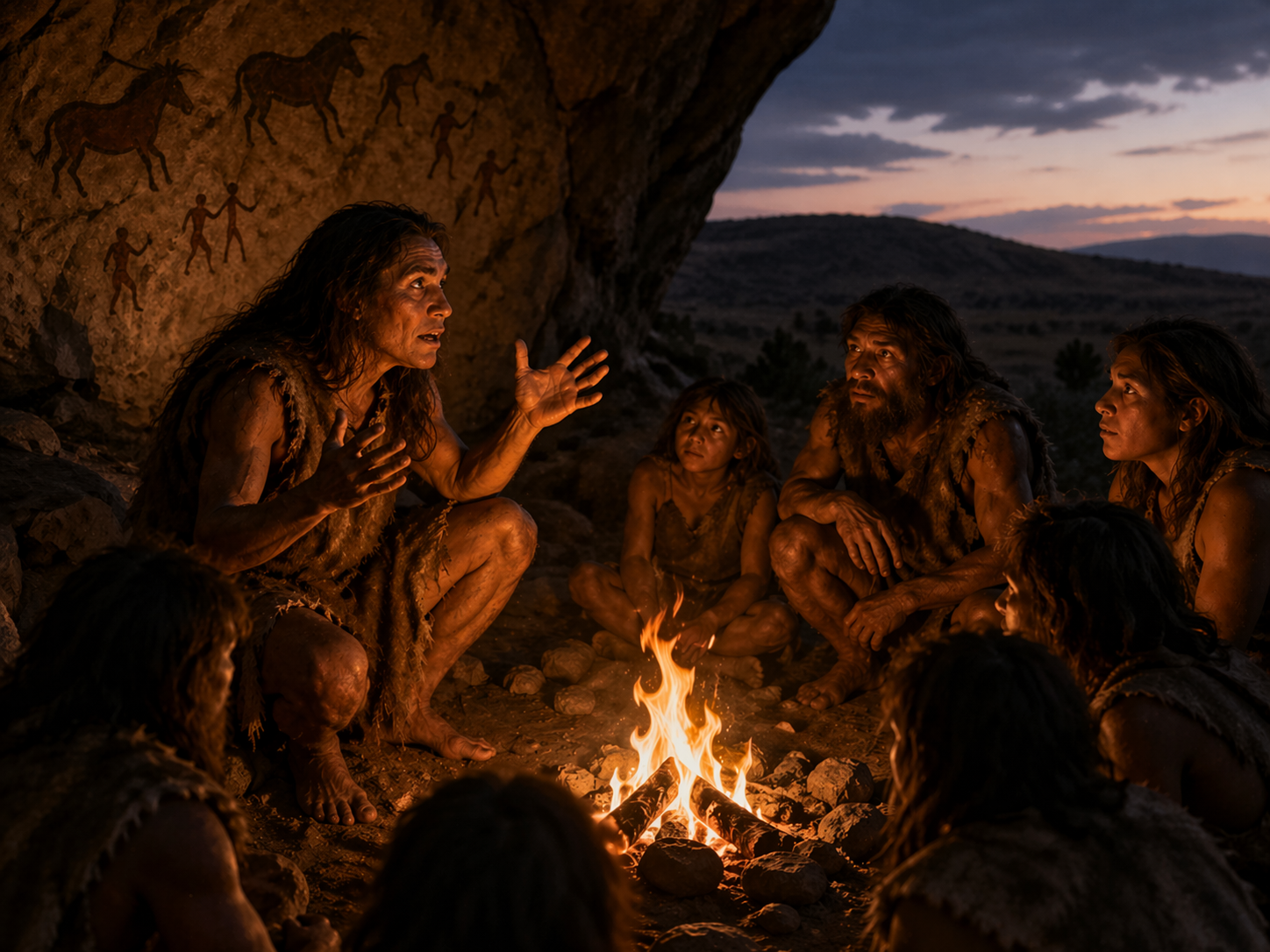
This is as far as social consciousness (i.e., human joint attention) gets us, in my view. Human beings with social consciousness created and reinforced communal intersubjective meanings collectively, using all forms of still-developing proto-communicative ‘language,’ like voice modulation (perhaps the first ‘music’), gesture (the first ‘dance’), and pretense (the first ‘acting’)—combined to produce the first ‘story,’ perhaps, around the fire. The meanings they created became joint representations. To know, as a group, that “this tree is where D sleeps” is a joint representation and can be ‘carried,’ essentially, by the group across space and time, as shown on the right half of the above diagram—common knowledge helps the group function when a member, such as E, is substituted for another, for example.
But these joint representations cannot be maintained for long outside of the group that creates them, because the individuals in the group have social consciousness, not yet robust individual consciousness. They can collectively hack, in my view, their episodic memories to remember (i.e., internalize) intersubjective, joint-representational meanings but lack the internal cognitive necessities, including a strong semantic memory system, to make optimal use of their new mobile, joint-attentional selection environment.
When human cognition evolves to make nearly immediate and automatic use of this joint-attentional selection environment, the resulting humans have individual consciousness. When our little tribe of four is creating and maintaining intersubjective meanings together, the group occupies both ‘stage’ and ‘audience’ for their performances. For a creature with joint attention, that is a unique and uniquely intense experience. The participants marking a tree as a boundary to their territory—using ritualized activity, perhaps—are both performing their meaning-making (or meaning-reinforcement) and watching it, both on the stage and off it.
My theory suggests that this ‘stage’ for the processing of intersubjective meaning, connected with memory systems required to store them, became internalized in humans as immediate and working memory systems. Although I believe that consciousness is more than working memory, I’m in good company thinking that it’s a central and important part of it.
