
Climate, Not Weather

The purpose of public education in the United States is to provide for effective social cohesion through a diffusion of common knowledge. That high-level purpose, at least, is what generally emerges across state constitutions about public education—when a purpose is explicitly mentioned. That is, most states emphasize that public education should be free, universal, or equal-access; that it should be thorough, efficient, or uniform; that it should provide for a diffusion of knowledge; that it should facilitate the preservation of civic life; and that it should promote character development and moral virtue. Only a small handful of the fifty state constitutions mention personal development or potential or workforce readiness as an aim of public education.
Why is the purpose of social cohesion important? The first quote we have to address this question is from Sam Harris, on the Blocks Podcast:
When you see someone out in the world behaving like a maniac—on social media or online—saying crazy things or spreading crazy lies or reacting to other people in ways that seem sociopathic, I think everyone’s default setting is just to take that at face value and react to that, like “Look what’s happened to this guy. This guy used to be a good person, and now he’s a total fucking asshole.” What you’re not seeing is how polluted that person’s information landscape is. You’re not seeing what made them that way. You’re maybe seeing some of it, but this person has stared into the hallucination machine from a different vantage point, and they got tuned up with all of this misinformation and half-truths and calculated lies, and then they just get set off on some trajectory that seems completely illegitimate from where you’re sitting.
I think it’s appropriate to have a measure of compassion for the fact that everyone has been inducted into this mass psychological and social experiment that is not turning out well. Everyone is being driven crazy by their engagement with these tools, and so I think it’s appropriate to disengage in a variety of ways and then to notice just how the evidence of pollution becomes more visible. . . .
The truth is not having a space in which to react immediately to something happening—to you or anyone else—I’ve now found is a great blessing. . . . I didn’t actually have to have an opinion in real time about everything.
Social cohesion is a long-term lift. If knowledge building is the weather, then cohesion is the climate. As it stands, education is perfectly placed as an institution to help address long-term social sicknesses like the one described above.
The second quote, from Cultural Evolution, by Alex Mesoudi, hints at the big picture for cohesion:
Social cohesiveness might seem to be a vague, intangible concept. However, much evidence exists in social psychology and, more recently, experimental economics to suggest that ingroup identity and ingroup cooperation can be measured and has real-world consequences. . . .
Turchin proposed that social cohesiveness is a second state variable that might explain why empires gradually rise and fall over several centuries. Unlike logistical loads, which impact empire size relatively quickly on the order of weeks and months, he argued that cohesiveness takes several centuries to increase and decrease. To test this hypothesis, Turchin constructed a second-order model containing functions for both empire area (A) and cohesiveness (C). . . .
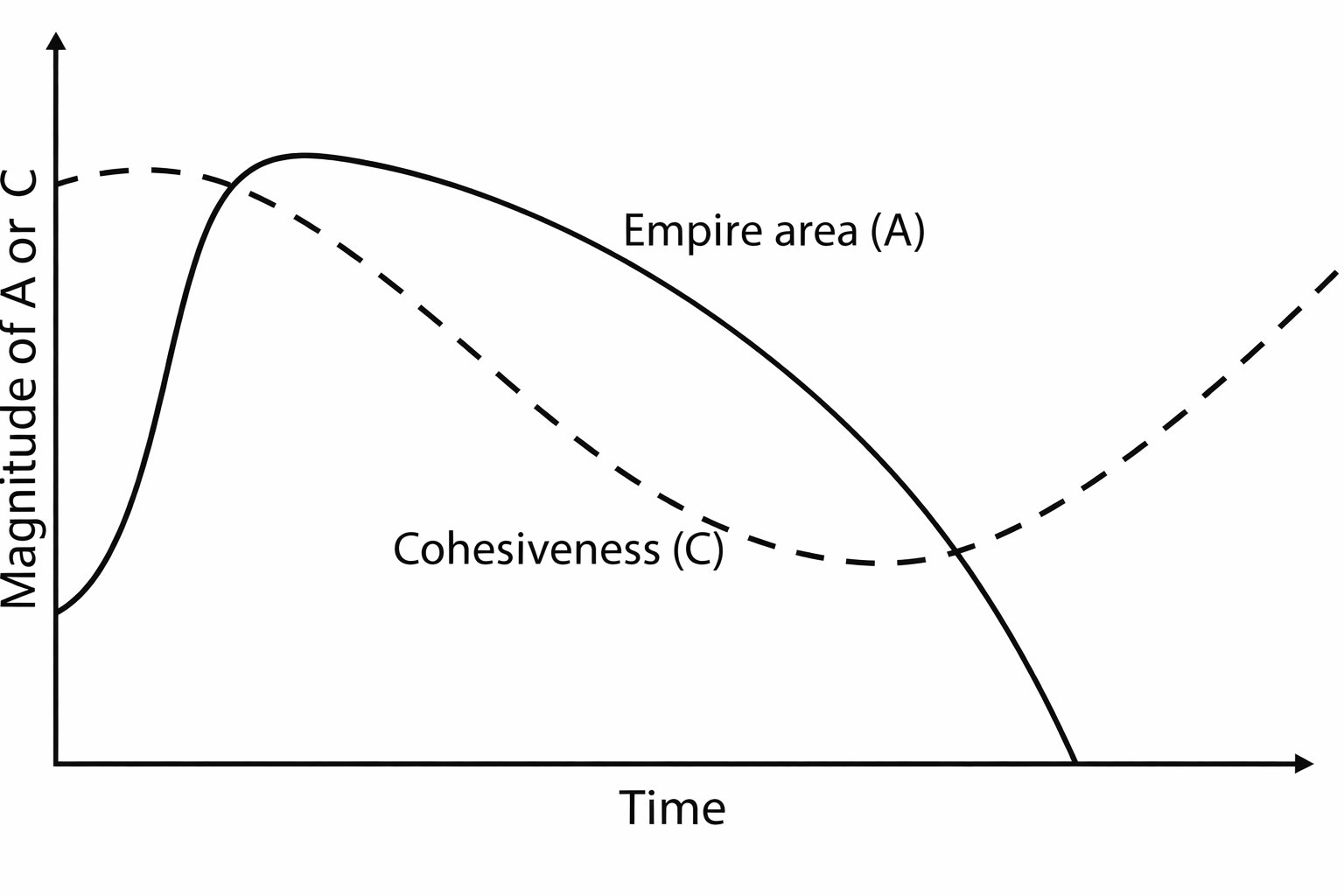
We can see how the initially small empire increases in size due to its high cohesiveness, followed by a gradual decline in area as cohesiveness also drops. By the time cohesiveness starts to rise again (due to the small size of the shrinking empire) it is too late, because a positive feedback cycle has kicked in whereby small area reduces resources, which reduces area even faster. . . . A novel prediction to come from Turchin’s cohesiveness theory is that empires should originate predominantly from frontier regions where cohesiveness is highest. Sure enough, Turchin found that of fifty geographical regions in Europe analyzed during the period 0–AD 1900, the majority of regions were either frontier regions and gave rise to an empire (eleven regions) or were not frontier regions and did not give rise to an empire (thirty-four regions).
Finally, from a recent piece by Willingham and Hirsch:
Readers and writers within a culture share more factual knowledge than those across cultures. People within a culture share more knowledge because they have similar experiences, interpret these experiences in more similar ways, and share similar values . . . The injunction to writers to “know your audience” really means “think about what your audience knows” . . .
If a school switches from a curriculum that ignores the importance of knowledge building to one that prizes it, how will reading instruction advance? . . .
If the goal is better performance on a standardized reading test (that is, one that is not tied to curriculum topics) we would not predict an immediate improvement—for example, at the end of one year of implementation. Our guess is that this progress will take three years or more. Here’s why: Shared content knowledge contributes to reading because writers omit information they assume the reader already knows. If we’re hoping to see improvement on state tests that were not written to align with a curriculum, educators can’t know which knowledge students need to acquire to do well on the tests. Hence, the goal we’re setting for knowledge building is really that students will know much of what is expected of a competent reader of their age in their culture. That’s great preparation for life after school, but it’s an ambitious goal. We expect that such broad knowledge accretes over years, not months.
