
Fusion Is More Powerful Than Fission
The Destiny of Man is to unite, not to divide. If you keep on dividing you end up as a collection of monkeys throwing nuts at each other out of separate trees.
Darwin did not use the phrase ‘survival of the fittest’ in the first edition of On the Origin of Species, though by 1869 he was using the phrase—Herbert Spencer’s—as a convenient alternative to ‘natural selection.’ In Darwin’s mouth certainly the two phrases meant the same thing, but after 150 years now of swishing, gargling, and expectorating these terms conversationally, the singular meaning has split into two. Now, when people say ‘survival of the fittest,’ they imagine—by way of the word ‘fittest’—strong, big, fast individuals, “top specimens,” who are driven or guided by this force, along with their weaker, smaller, and slower compatriots. All are animated, according to this view, to be the ‘fittest.’
But neither groups of animals nor individual ones—including humans—are unconsciously ‘moved’ by natural selection. They do not wake up every morning (or evening, or ever) with the unconscious urge to be the fittest-est creatures around. They show up, with heritable variation and they experience differential reproductive success in their physical environment. They are motivated by basic physical and sometimes social needs, but they are not—and could not possibly be—motivated by natural selection in any way.
It is this mistake, along with the one that lyingly portrays natural selection as “red in tooth and claw,” that lead people to believe that disruption and competition and conflict are human first principles—that if there’s no fight, there’s no improvement, no stable existence even—and that for any fight, regardless how senseless, wasteful, or destructive, one can always find a creative justification—one often supplied in hindsight and, in substance, by the work of everyone else cleaning up the mess together.
It may be that we can be forgiven our ‘survival of the fittest’ hangups a little since scientists are always comparing us with chimpanzees. But we share the same amount of DNA (98.7%) with bonobos too.
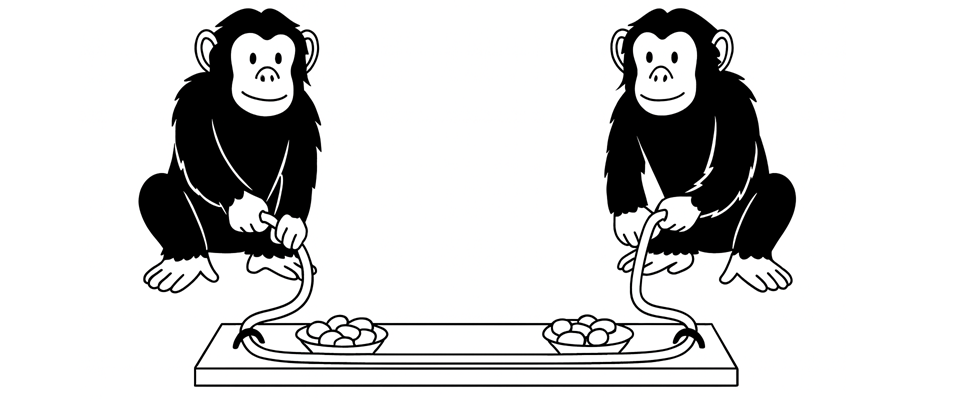
In order to test overall cooperation in bonobos and chimpanzees, we did a different test. We threaded a rope through the loops on either side of a plank. Food was placed on the plank, and the plank was set out of reach. The only way to pull the plank forward was to pull on the rope at the same time as someone else (the ends of the rope were placed within reach of the apes but were too far apart for one ape to pull). If someone pulled too hard, or tried to pull it unaided, the rope came unthreaded and no one got the food. Success required cooperation.
We tested chimpanzees, and a few pairs of them were extraordinary. They spontaneously solved the problem on the first attempt. They knew when they needed help, they knew who was the better cooperator, and they could successfully negotiate—even without norms and language. But we could not take the chimpanzees from successful pairs and re-pair them with others. They were too intolerant of one another.
Nor could chimpanzees share food unless it was divided into two piles. All it took for chimpanzee cooperation to fall apart was to set the food in one pile in the middle of the plank. One chimpanzee would end up eating all the food and the other chimpanzee would either quit or sabotage the game by pulling the rope out of the loops. Even though the same two chimpanzees had cooperated successfully before, they couldn’t negotiate the division of that one pile of food.
Unlike the chimpanzees, who had months of practice and preparation for this test, bonobos could cooperate immediately. When we moved the food from two piles into one pile they cooperated. When we mixed up the pairs, they cooperated. In all situations they ate together happily. And not only did they share the food, but when someone reached the food first they left enough food for their partner, so that each ended up with half. Bonobos had beaten the chimpanzees at solving this cooperative problem. . . .
The bonobos had ‘beaten’ the chimpanzees? Even when we are extolling the virtues of collaborative orientations over conflict orientations, it seems we can’t get the fetishization of conflict-display out of our heads. We see it every election cycle, with pundits of all genders—lay and professional alike—unable to think about even ordinary civic disagreement without dipping into the armory, or the tiresome ‘get-shit-donnery’: they’re in the ‘trenches,’ pulling the ‘trigger’ on a decision, someone ‘torpedoes’ a bill, someone else ‘fires back,’ a candidate ‘goes on the attack’—no one really knows much, so they have to compensate with dramatics. If you can’t explain a policy, you can at least narrate a brawl. It’s epistemic insecurity dressed up as swagger. For these geniuses, any form of the word domestication can (ironically) make stomachs turn, but it is self-domestication, not conflict, that is what is behind our species’ success story:
Domesticating a wolf brain or an ape brain is impressive. But when you domesticate a human brain—this is when the real magic begins. An ultracultural species is born. A unique type of friendliness must have evolved in our species that allowed for larger group sizes, higher population densities, and more amicable relations between neighboring groups that in turn created larger social networks. This encouraged the transmission of more innovations between more innovators. Cultural ratcheting went from slow and sporadic to fast and furious. The result was exponential growth in technology and the emergence of behavioral modernity.
In this interesting new paper from Carsten K.W. De Dreu, it is indeed suggested that conflict is not necessarily fundamental to who we are as humans and could be instead better conceptualized as a byproduct of our more collaborative tendencies (see linked paper for references):
When neighbouring groups and communities are peaceful and non-threatening, individuals may still invest time, skills, and effort in fighting them. One reason may be that individuals perceive their ‘in-group’ as more worthy than ‘out-groups,’ and out-groups as less likeable and worthy than their in-group. Such social bias—more positive about one’s in-group, and more negative about out-groups—is seen across cultures, and it is seen in human infants less than a year old. It is seen too in non-human primates like chimpanzees and bonobos . . .
For humans, there is good evidence that positive feelings about one’s in-group support helping in-group individuals. It would then be a small step to also assume that seeing ‘them’ as less likeable in comparison might cause individuals to be predominantly hostile and aggressive towards out-group individuals. . . .
In a series of studies with human participants from across the globe over 12,000 individuals residing in 51 countries worldwide . . . were given money that they could use to benefit others—i.e., in an investment game—and in another task, to harm others—i.e., in a contest game. And these others were of two kinds—they were individuals from one’s own community, or they were from another community . . .
Humans were ‘parochial’ cooperators. Even in our simplified and rather abstract experiments, individuals cooperate more within than between groups.
[But] in tens of thousands of decisions made by individuals from across the globe, individuals were less rather than more competitive and aggressive towards members of out-groups. Individuals behaved as ‘nasty neighbours,’ competing more within than between groups . . . .
To serve oneself and one’s in-group [‘me and we’], individuals may engage in inter-community trade and exchange of people, goods, and services. And they may participate and invest in coalitionary aggression to seize the resources held and produced by out-groups. If true, participation in coalitionary conflict rests on selfishness and, perhaps, on parochial solidarity—a preferential sympathy with, and concern for the welfare and well-being of, the members of one’s own group, community, or society.
So, conflict perhaps results from cooperation and consensus, our true inner drives and guides, whether we like it or not. We saw that children less than a year old have this ‘drive.’ And they have it—we have it—so that we can learn how to live in and know our human communities. Outsiders, thus, represent socially unknown agents, each accountable to possibly wildly different community norms. There is little or no shared meaning—knowledge—about each other or with each other, so we each stick with our own consensuses:
Three- and 4-year-olds were introduced to a group of four adult women. Several unfamiliar objects were laid out on the table and, using an unfamiliar name (for example, “show me the modi”), the experimenter asked the women to point to one of the objects. Three women promptly pointed to one and the same object, but the fourth—a lone dissenter—pointed to a different object. Children were then asked to indicate which object they thought was the modi . . .
If children were sensitive to the pattern of pointing, they were making sense of it in terms of agreement and disagreement, not in terms of liking and disliking. Indeed, when children were asked to say which object they thought was (for example) the modi, both age groups agreed with the consensus, not with the lone dissenter . . .
Two members of the consensus left. This meant that one member of the consensus remained, together with the lone dissenter, and they continued to serve as informants. Several more unfamiliar objects were presented, and the children were given various opportunities to indicate which person, if any, they preferred to learn from. Both 3- and 4-year olds displayed a clear preference for the former member of the consensus, not the lone dissenter. They were likely to ask her for the names of unfamiliar objects, to agree with the names that she supplied, and to eventually say that she was better at answering questions than the lone dissenter. . . .
Perhaps children are not interested in the truth, or have, at best, an incidental interest in it. When they turn to other people for guidance, perhaps they are trying to find out what counts as the “proper” way to behave or think. Their goals may be normative, rather than epistemic. In support of this argument, consider the fact that children are members of a highly social species, with a plethora of cultural practices involving tools and symbols. In learning how to use a tool by watching a demonstration, children readily take a normative stance, as we saw in Chapter 3 [I urge you to get Harris’s book] . . . .
So young children’s overriding goal when they look to informants for guidance may be to learn about the norms and practices of their community. [For instance, is it the norm here to rectify knowledge asymmetries by teaching or allow them to persist because ‘survival of the fittest’?] To the extent that they seek such normative information, children might be especially inclined to trust informants who honor rather than breach those group norms . . . children are vigilant sociologists, noticing where there is a consensus and where there is dissent. Yet the motive for their vigilance is not to discover the truth, but to gather information that will enable them to fit into their own cultural group. . . .
The evidence . . . shows that children are not interested in conformity to just any group. They are especially swayed by people who fit in with the norms and conventions of their own group. They are prone to trust someone who looks and sounds like them. These findings are nicely consistent with the conformist bias emphasized by Richerson and Boyd (2005) as a key component of cultural learning, but they add an important twist. They show that children do not simply assess the frequency of a given behavior, endorsing and adopting behaviors that are widespread. They also prefer to emulate a new—and hence, from their perspective, rare—variant, provided it is modeled by someone who has elicited agreement rather than dissent from members of their group. Thus, children do not simply conform to frequently modeled behaviors; they conform to the judgments of people who have shown themselves to be conformists.
