
Always Be Teaching
From the Introduction in the book Rhetoric and Resistance, by author Maeve Adams, with my boldfaced emphases:
In 1938, speaking to missionaries from Britain and North America, Mahatma Gandhi was asked to explain his strategy of nonviolent resistance. He responded by reciting, from memory, several stanzas of Percy Bysshe Shelley’s Mask of Anarchy (written in 1819; published in 1832), presenting poetry written in response to a past injustice as a still-pertinent resource for explaining and animating the work of resistance more than one hundred years later . . .
Prior to reciting the poem, Gandhi had been explaining that, contrary to popular understanding, nonviolent resistance is not “pacifis[m]” (87). “Non-violence,” Gandhi insisted, “is not passivity in any shape or form. Non-violence, as I understand it, is the activest force in the world. Therefore, whether it’s materialism or anything else, if non-violence does not provide an effective antidote, it is not the active force of my conception” (87). To exemplify his meaning, he recited [part of] Shelley’s poem . . .
Stand ye calm and resolute,
Like a forest close and mute.
With folded arms and looks which are
Weapons of unvanquished war.
And if then the tyrants dare
Let them ride among you there,
Slash, and stab, and maim and hew--
What they like, that let them do.
With folded arms and steady eyes,
And little fear, and less surprise,
Look upon them as they slay
Till their rage has died away.
Then they will return with shame
To the place from which they came,
And the blood thus shed will speak
In hot blushes on their cheek.
Rise like Lions after slumber
In unvanquishable number,
Shake your chains to earth like dew
Which in sleep had fallen on you--
Ye are many--they are few.
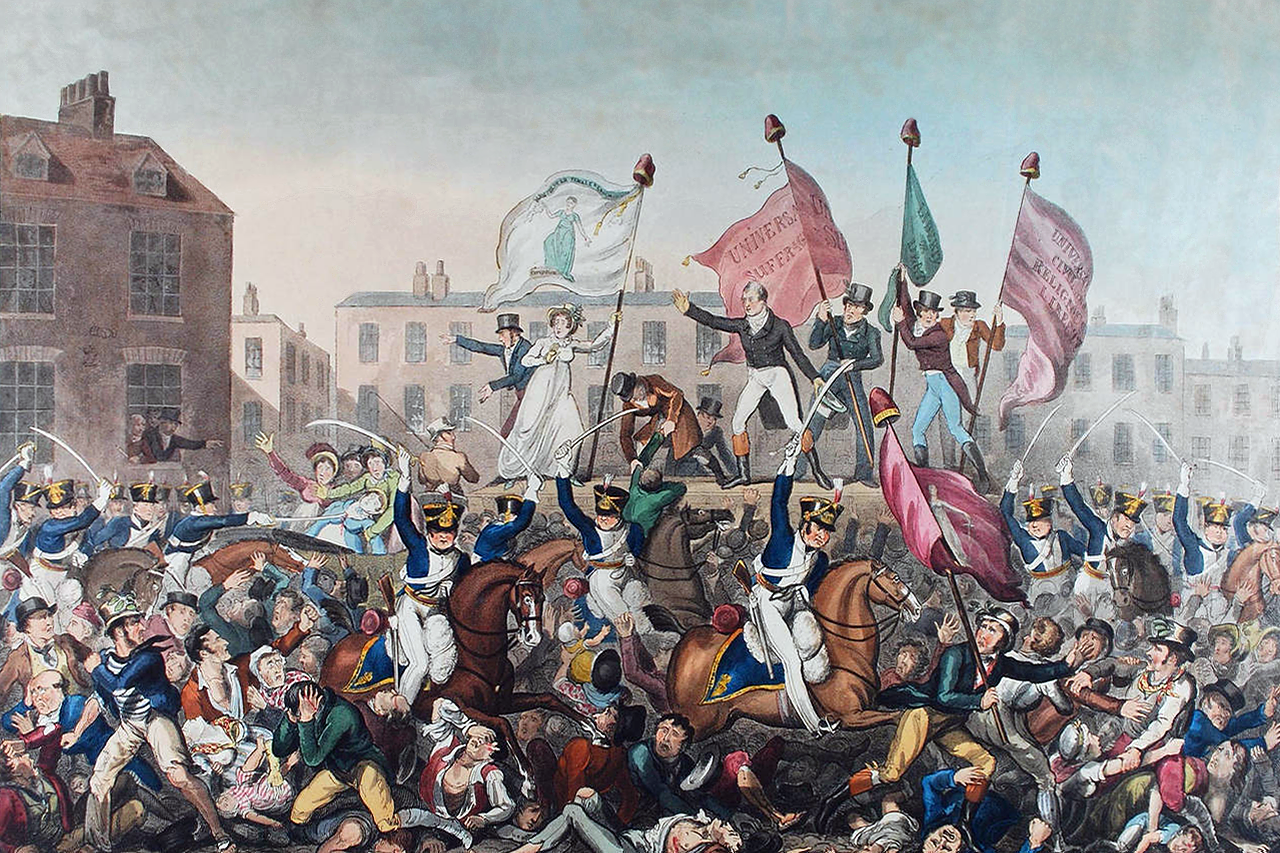
Masque of Anarchy is a marvelous poem—those few stanzas that the author has taught me, anyway, are impressive, especially in the service of understanding, perhaps, some nuances in the deployment of nonviolent resistance. The poem’s most immediate subject is the brutal slaying of more than a dozen people, including children, at St Peter’s Field (now St Peter’s Square), Manchester, on August 16, 1819.
What was the crowd of 60,000 or so protestors there asking for on that hot and finely unclouded day? They were asking for manhood suffrage—that all working men should have the right to vote. It is a bit of modern myth—fueled by motivated (and unmotivated) ignorance—that all white men in the West have had the vote from the beginning of time. But of course that’s not true. Fewer than one in ten men in attendance at the Peterloo Massacre had representation in Parliament to address the high bread prices, chronic unemployment, and severe economic recession brought about, in part, by the end of the Napoleonic Wars in 1815. Suffrage was suffering much the same in the United States at the time. Until about the 1850s, rich men had the vote, not all men, nor anyone else—property ownership and taxes were (and often still are) simply proxies for ‘rich.’ Across much of the Western world, universal suffrage for all men, including poor ones, occurred just a generation or so prior to the franchise becoming truly universal (on paper).
This is, indeed, why women and children—i.e., entire families—were at St Peter’s Field on the 16th of August 1819, in their Sunday best—many having marched in file there, carrying banners for miles. They were supporting universal suffrage and democratic reform, with many organized ‘female (democratic) reform societies,’ made nobly conspicuous at the protest by their head-to-toe white garments, taking the lead in arranging events. It is why two-year-old William Fildes was on hand to be the first victim of the day, dropped by his mother as she fled the government’s men on horseback wielding sabres. And it is why, of the hundreds of protestors killed (trampled or sabred) or wounded that day, the unborn daughter of Elizabeth Gaunt was among their number. She died after her mother was badly beaten while in custody.
Shelley’s words, published more than a decade after the event due to their controversial nature (and which powerfully punctuate the trailer for the 2018 movie Peterloo), do not describe (or valorize) a battle or conflict in the same way as, say, Francis Scott Key’s Defence of Fort M’Henry does.
The stanzas provided above identify our protestors—the ‘ye’ that stands as a forest—and their ‘tyrants,’ riding, slashing, stabbing, maiming, hewing, as two very different entities—the former something like Emma Lazarus’s “tired . . . poor . . . huddled masses,” and the latter as a morally and physically distant and disorganized raiding party having a temper tantrum.
These closing stanzas of Masque of Anarchy teach us to view (the) conflict this way. The people—proud, rooted, huddled, and eternal like a forest—should know that they are of (this) nature; that they are here, alive, unvanquished by whatever challenges lie in their long and ancient history, and unvanquishable in their sheer numbers. This new knowing provides for new seeing and new acting. They fold their arms (and weapons)—affectedly bored, perhaps, of the persistently recurring vanity and selfishness that play themselves out like fevers across human generations, with no lessons learned; closed off, certainly, in gevuric defiance of the fevered intentions of the tyrants—and they look, merely, steadily, calm and resolute, upon the tyrants, much as God might look upon the passing events of the mortal world. We are taught that humanity is ultimately indestructible when it is awake to its own power and numbers. The chains it carries are of its own dreamlike imaginings.
Shelley teaches this lesson to Gandhi, who in turn teaches it to the same ‘tyrants’ and the same ‘people,’ again—again—again—just on a different day, in 1938 this time. One thing that seems clear from this lesson is that the people need never accept the premises of their current tyrants—a point Ghandi alludes to just after he refers to non-violence (for the second of three times) as the ‘activest’ force in the world:
When the position is examined in terms of non-violence I must say it is unbecoming for a nation of 400 millions, a nation as cultured as Japan [China], to repel Japanese aggression by resorting to Japan’s own methods. If the Chinese had nonviolence of my conception, there would be no use left for the latest machinery for destruction which Japan possesses. The Chinese would say to Japan, ‘Bring all your machinery, we present half of our population to you. But the remaining two hundred millions won’t bend their knee to you.’ If the Chinese did that, Japan would become China’s slave.
The teaching functions employed and deployed by both Shelley and then Gandhi are explored also by the author, in their own language of critical scholarship:
Ventriloquizing Shelley more than a century after the poem’s composition and the historical contexts it reflects, Ghandi offers to his auditors no mere artifact of a distant past but an immediately pertinent resource—both aesthetic and political—to be mobilized when and where “tyran[ny]” occasions its necessity. As Ghandi’s usage suggests, a poem that both describes and embodies resistance offers a strategic lesson in how to resist effectively as much as it also offers a history lesson. [Shelley names names of tyrants: Castlereagh, Eldon, and Sidmouth, for example.] The poem thus remains a resource long after the poem’s own historical context is past because the form presents a replicable strategy, available to be mobilized as “active force”: a literary art, as in ars or “craft,” of dissent . . .
The second half [of this book] explores specific dissenting strategies that in form, if not also content, readers will find even more familiar since variants of these strategies remain part of modern “repertoires of collective action”—a term I borrow from the sociologist Charles Tilly, who uses it to describe the cluster of resistance practices that characterize modern social and political activism. Tilly contends that “sometime in the nineteenth century, the people of most western countries shed the collective-action repertoire they had been using for two centuries or so, and adopted the repertoire they still use today.” . . . Writing and reading literary texts, I furthermore maintain, thus plays a crucial role as a form of social and political action in that far-reaching transmission. . . .
There is nothing—nothing—in the above that is not teaching and learning knowledge: the only thing that can truly empower successful resistance.
