
A Sense of Place
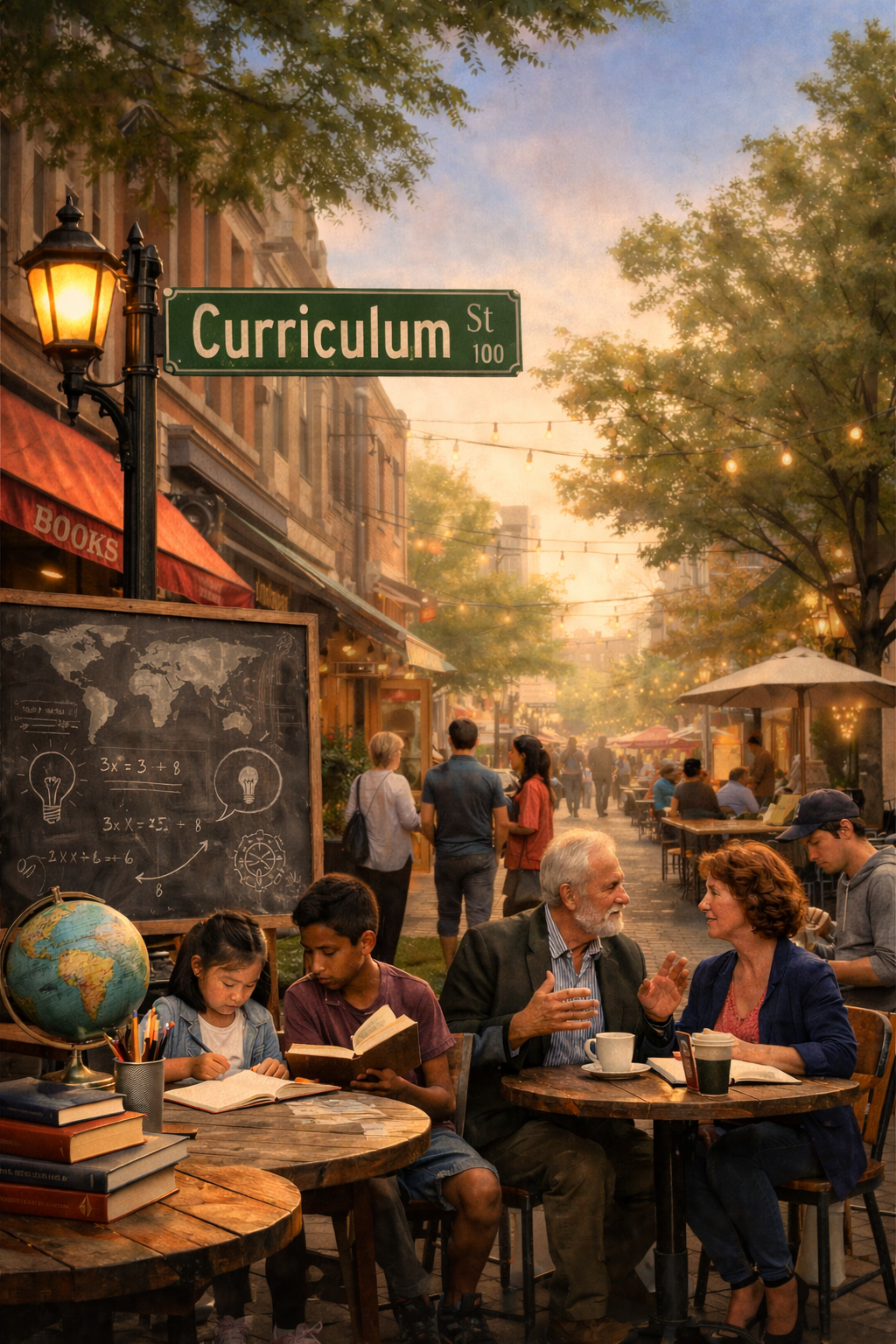
This is from the book Great Streets, by Allan Jacobs. There is something, it seems to me, about ‘great’ streets (in Jacobs’s view, anyway) that is in common with ‘great’ curricula (bold emphasis mine):
First and foremost, a great street should help make community: should facilitate people acting and interacting to achieve in concert what they might not achieve alone. Accordingly, streets that are accessible to all, easy to find and easy to get to, would be better than those that are not. The best streets will be those where it is possible to see other people and to meet them; all kinds of people, not just of one class or color or age. The criterion would work at many geographic scales, from citywide [grade, course] to neighborhood [topic, lesson], which opens the possibility of types of great streets. Great neighborhood streets would be the foci for people of a smaller geographic area than of a city, conceivably an area as small as the street itself. A great street should be a most desirable place to be, to spend time, to live, to play, to work, at the same time that it markedly contributes to what a city should be. Streets are settings for activities that bring people together.
A great street is physically comfortable and safe. A great street might be cooler, more shady than another street on a hot summer day and therefore more pleasant to be on. There would be no sudden, unexpected gusts of wind off buildings. If there are many people there should not be so many as to make it difficult or uncomfortable to walk; it should not provoke a sense of confinement. Physical safety is another matter, and it can mean many things; but the general concern is relatively straightforward. One shouldn’t have to worry about being hit by a car or truck or about tripping on the pavement or about some other physical thing built into the street being unsafe. Lurking human threats to safety? Robbers and muggers? No, that is not the subject here: no recommendations for doing away with trees or permitting only small trees to discourage molesters, no prohibition of set-back entryways that can hide thieves. Light, by all means, to see the way and to see others, and ramps rather than steps where helpful for the comfort and safety of the handicapped and elderly, but no sanitizing of streets to avoid societal misfits.
The best streets encourage participation. People stop to talk or maybe they sit and watch, as passive participants, taking in what the street has to offer . . . Social or economic status is not a requirement for joining in . . . .
The best streets are those that can be remembered. They leave strong, long-continuing positive impressions.
Perhaps these similarities have to do with both streets and curricula delivering us, ultimately, a certain sense—and sensibility—of place, with both constraints and affordances.
I’ll spare readers my commentary on every highlight, except two. First, I think we do a lot of ‘sanitizing’ of curricula to try to avoid ‘misfit’ behavior. I do not mean the ‘sanitizing’ that sees us avoiding 69 as an answer to a math problem, or any other text-level scrubbing or polishing. What I mean is using the assumed behaviors and intentions of students (i.e., stereotypes about what the ‘kids are like’) as bases, or justifications, for the structure or sequencing of a curriculum. To say that the kids don’t want to be there, for example—or that we’re selling something they don’t want to buy—so design accordingly, is to get things crucially, and invidiously backwards, even if it’s true to a tot that no child ever wants to be at school or ever picks up what you’re putting down. Simply put, what virtually everyone believes they are signing up for with schooling is for the arrow of influence and guidance to proceed primarily from curriculum—writ large—to student behavior, not the other way around. Of course student behavior must be considered, but not as that of an ‘audience,’ which can change a ‘performance’ over time, but as a student body whom we are responsible for changing and moving, through our performances.
Second, and connectedly, ‘passive’ is a perfectly good word, a perfectly good state of mind, and a perfectly good way of being from time to time, as Jacobs’s choice of wording, born far away from the bubble of education, suggests. We have just distorted its common meaning—‘accepting or allowing what happens without active response’—by connoting it with ‘weakness,’ ‘subjugation,’ and ‘compulsion.’ No one wants to have that bias, but we let that weird, awkwardly imitated machismo show when we talk about ‘passivity’ as though it meant ‘devoid of power or volition.’ At the very least, ‘taking in what’s on offer’ does not mean ‘not participating.’
